Below are some of my rambling notes, I’m still paying off The Conference Tax for being gone for so long. The true heroes of conferences are the folks who hold the fort down at home 🫡🫡🫡.
An A+ Schedule
You should watch all of them, in order (don’t skip the lightning talks either!)
Jeremy, Joe, and Mark created a fantastic schedule. It had a clear, authorial intent with a proper cadence.
That’s why I love single-track conferences so much! You can really see the story the organizers want to tell, and how they want the conversation to be guided. And everyone has common ground for discussion.
My talk
I closed out the conference with my second talk, 5 ways to invest in yourself for the long haul .
- Slide links: https://thomascannon.me/assets/talks/brr-2026/
- Video will be forthcoming, thanks to Confreaks!
Perfectly placed in the schedule
Folks (and myself, honestly) were joking about my bad luck getting the last slot of the conference. But, to be honest, I’m honored. Its placement in the schedule felt right. We’d just spent the last two days around each other, endlessly discussing the state of the industry, lessons learned, and imagined futures. I wanted people to come away from it feeling empowered and eager to carve their own path.
“What if it’s fundamentally busted?”
One worry I had was that the talk wouldn’t click for folks due to its unconventional introduction. Reviewers kept saying they want guidance and clear orchestration on what I’m going to talk about.
There was a single summary slide at the front to outline the terrain, I knew that Jeremy was going to emcee. I wanted the focus of my talk to be on the stuff I’m doing, why I think it’s valuable, and how someone could adapt/adopt it. If I did your regular “here’s what I’m going to talk about in this talk, and how it led to result X/Y/Z,” that’s different and prescriptive IMO.
I am a white, male, DINK, newly-minted CTO at my $dayjob (@dayjob, there you go Jeremy). Going on stage, outlining my career path, and “dropping nuggets of wisdom” would be A Choice™. And I’d just experienced one of those talks a few weeks back, and it felt exactly like I feared: self-congratulating, pointless, meandering.
Also, trying to orchestrate what the talk is about might have caused people to turn their brains off. “Oh, write better commit messages and blog more?” Snooooooze, we all hear that. But walking backwards into that advice? That’s helpful!
Thanks to everyone for “getting it.”
From what I heard after I left the stage, my bet appears to have paid off. Thank you for trusting where I was going. And thank you to everyone who told me they found the talk inspiring, hopeful, useful and that it gave them ideas on how to build their own career. My door’s always open if you want to talk more about it!
Epilogue: The lightning talk stomach drop
Fun fact: Brooke Kuhlmann’s lightning talk made me sweat bullets. I closed out the conference and kept my talk’s details pretty close to the chest, so when Brooke started talking about git-lint and commit message formatting, I literally texted a friend:
ha ha I’m in danger
Thankfully, our talks actually ended up being great complements to each other! And I want to try out git-lint for myself!
The AI Roundtable
Even the most cursory glance at my writing & web presence makes it clear that I have fundamental and profound disagreements with the bubble that is labeled “Artificial Intelligence.”
I think one of the most important parts of the conference for me was the “AI Roundtable,” as hosted by Jeremy. And he deserves specific & significant credit for the way he moderated the discussion. It was focused on qualitative discussions, tightly scoped to how the environment relates to us as Rubyists. The second-order or broader factors were left at the door, not because they’re insignificant (they’re some of the most important discussions we need to be having right now), but because having the conversation from one Rubyist to another, about our language, in the same room, as humans, is a thing that we literally could not have outside a conference context.
I’m not going to go into details because it was a private gathering. But I will say that multiple perspectives were heard. We talked openly, freely, and person-to-person. And Jeremy made sure to keep that human connection in place, and for us to be mindful of the opportunity we had. And that’s very hard, stressful work. So, again, thank you to Jeremy for taking on the challenge.
Nothing was resolved, and it was never going to be in the span of 90 minutes. I’m still a major skeptic, and I am actively cheering for the bubble to burst so that we can create a more sustainable, ethical, democratic future. But I feel less alone. My perspectives have been challenged. I was able to voice some of my most pressing concerns for what our language’s future looks like. And I have even more respect for Rubyists.
Ruby passports are great!
If you haven’t gotten a Ruby Passport yet, you should go to a conference (preferably a regional conference close to home!) and fill out the form.
Before getting mine, I thought it was a fun, whimsical idea, a bit of neat swag. But, I’m not gonna lie, I did get a genuine rush getting the passport stamped. It was this physical, concrete, real ceremony representing the time and effort I put into going to this event, and what it means for me.
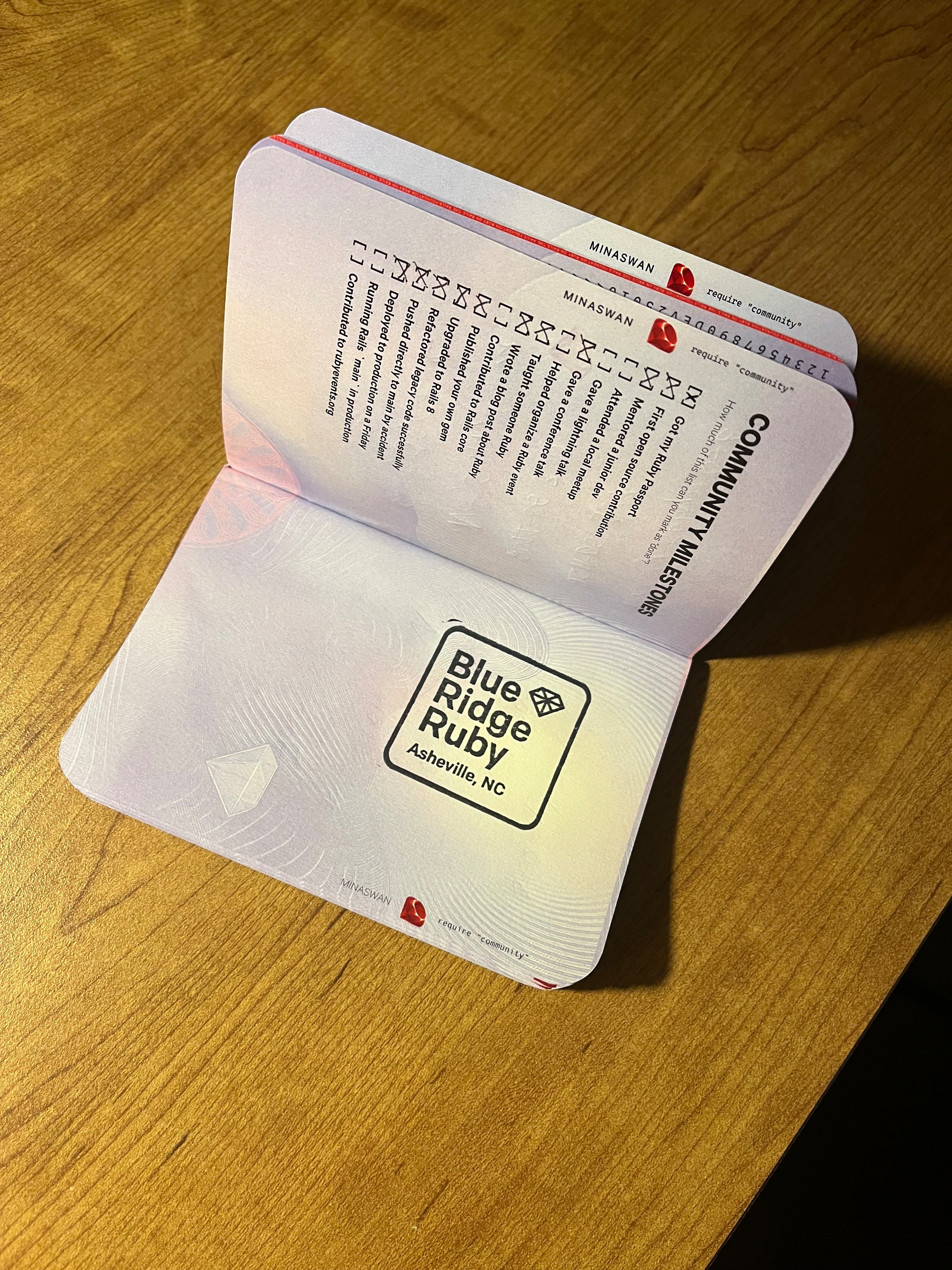
PS: our “annual report” for the Ruby passport for the Blue Ridge Ruby delegation is a lot of fun to scan through!
Misc. notes
- The venue was excellent; I’m delighted it was at the YMI Cultural Center, and I hope future iterations are there as well!
- Regional conferences are excellent! Keep going to them (or go to them, if you haven’t!)
Join the dinner table!
Start your Ruby Events profile! Join, lurk, and post on the Ruby Users Forum! We’re a welcoming bunch, and it’s always more fun together.